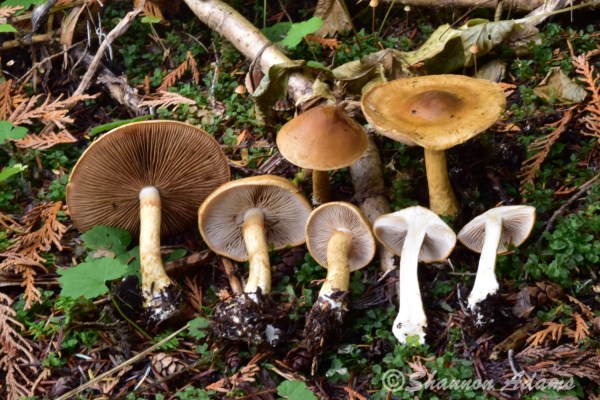
Cortinarius microspermus J.E. Lange, Flora Agaricina Danica 5: iii (1940) [MB#271088] Description:Cap 35 - 50 mm wide, pileus tawny yellow to red-brown on the disc, margin cream to white, viscid, gills pale clay-colored then milky-coffee to light ochre, stipe 30 - 80 mm long, 8 - 15 mm at apex, white or creamy-yellow with white... Continue Reading →
Cortinarius alboviolaceus (group)
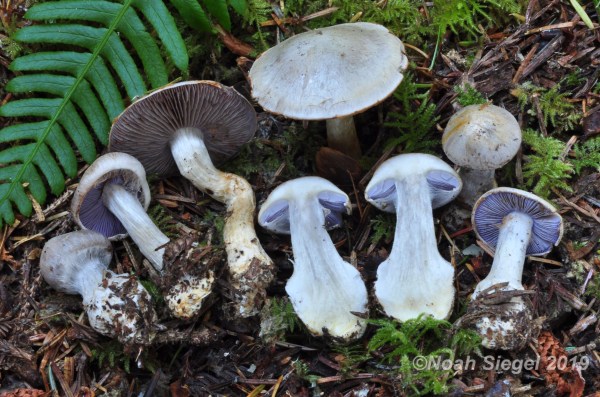
Cortinarius alboviolaceus (Pers.) Fr., Epicrisis Systematis Mycologici: 280 (1838) [MB#199674] Description:Cap 20 - 70 mm wide, viscid to dry, convex to plane with undulating margin, color variable ranging from silvery white to grey to lavender-gray, tan to yellow-ochre center common in mature specimens, cap margin slightly upturned and thin appearing paler than cap, covered in... Continue Reading →
Cortinarius traganus
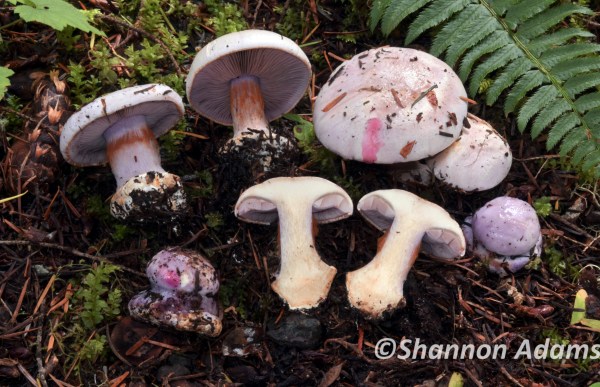
Cortinarius traganus (Fr.) Fr., Epicrisis Systematis Mycologici: 281 (1838) [MB#164677] Description: Cap 40 - 90 mm wide, hemispherical when young, then convex to plane, surface dry, tomentose, often cracked and scaled with age, lilac when young, fading to lilac-grey or pallid brown, gills ochre when young, darkening to rust brown, never lilac or purple toned,... Continue Reading →
Cortinarius distortus
Cortinarius laniger Fr., Epicrisis Systematis Mycologici: 292 (1838) The ITS region is the standard for Cortinarius phylogeny and species deliniation. However, there are known areas where species that appear morphologically distinct show slight ITS variation - below the typically accepted threshold of 99% (established in Garnica et al 2016). The case of Cortinarius laniger, solis-occasus... Continue Reading →
Cortinarius subminiatopus
Cortinarius subminiatopus Kytöv., Niskanen & Liimat., Index Fungorum 344: 3 (2017) Description:Cap 6 - 25 mm wide, conical to sub-umbonate, smooth, silky, coffee brown on disc to salmon pink on margin, cortina orange-pink to scarlet on cap margin and lower stipe, most vivid on button but present on all specimens, gills pinkish-orange to cinnamon, stipe... Continue Reading →
Cortinarius violaceus
Cortinarius violaceus (L.) Gray, A natural arrangement of British plants 1: 628 (1821) Description:Cap 40 - 150 mm wide, convex, dry, covered with velvety tufts or scales, giving a furred appearance, dark violet to deep purple, stipe 60 - 150 mm long, 10 - 20 mm wide at apex, clavate cortina purple, sparse, flesh deep... Continue Reading →
Cortinarius pallidifolius
Cortinarius pallidifolius A.H. Sm. (1939) [MB#253771] Description:Cap 42- 90 mm across, umbonate to plane to upturned, with persistent umbo, heavily glutinous, tawny-ochre, then yellow-ochre on margin, tawny- ochre on disc, cortina white under thick gelatinous, yellow-brown veil, gills off-white to buff, becoming cinnamon brown, stipe 58 - 83 mm long, 8-10 mm thick at apex, clavate, covered with glutinous yellow-brown... Continue Reading →
Cortinarius olympianus
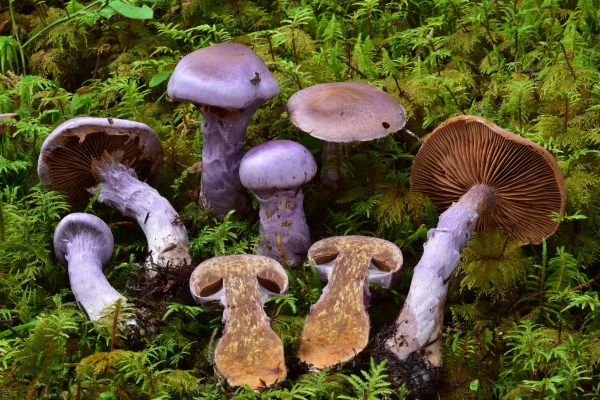
Cortinarius olympianus A.H. Sm., Contributions from the University of Michigan Herbarium 2: 13 (1939 DescriptionCap 30-65 mm wide, glutinous, convex and flat profile, without umbo, margin persistently inrolled, pale violet to lilac, deeper lilac at margin, pale lilac grey to tan to almost white at center of the disc when dry (purple tones return when... Continue Reading →
Cortinarius pini
Cortinarius pini Brandrud, Edinburgh Journal of Botany 53: 360 (1996) SDA 621 Cortinarius pini Description:Cap 15-55 mm across, thinly viscid, to dry with adhering debris, yellow-brown with paler margin (cinnamon rufous to cinnamon buff), hygrophanous blotches and streaks towards margin stipe 50-80 mm long, 7-11 mm thick at apex, sub-clavate, with pallid to cinnamon brown... Continue Reading →
Cortinarius albescens
Cortinarius albescens A.H. Sm., Lloydia 7 (3): 180 (1944) [MB#285690] Description:Cap 25-90 mm across, at first convex with broad umbo, spreading to plane, glutinous, variable in color from violaceous grey, buff, drab, cream to yellow-ochre on disc, cortina white, gills lavender, grayish-lavender, grey to cinnamon-brown, lavender tones may persist, stipe 50 - 120 mm long, 6 - 14 mm wide at... Continue Reading →