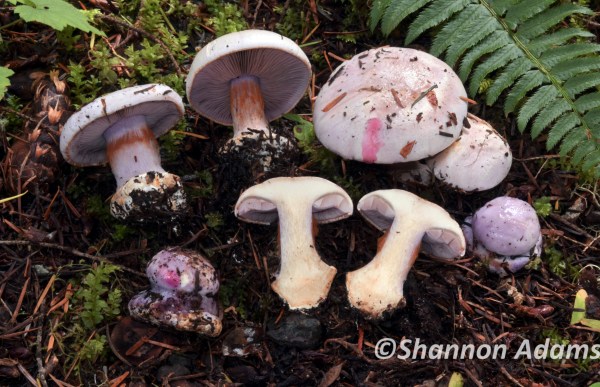
Cortinarius olympianus

Cortinarius olympianus A.H. Sm., Contributions from the University of Michigan Herbarium 2: 13 (1939 DescriptionCap 30-65 mm wide, glutinous, convex and flat profile, without umbo, margin persistently inrolled, pale violet to lilac, deeper lilac at margin, pale lilac grey to tan to almost white at center of the disc when dry (purple tones return when... Continue Reading →

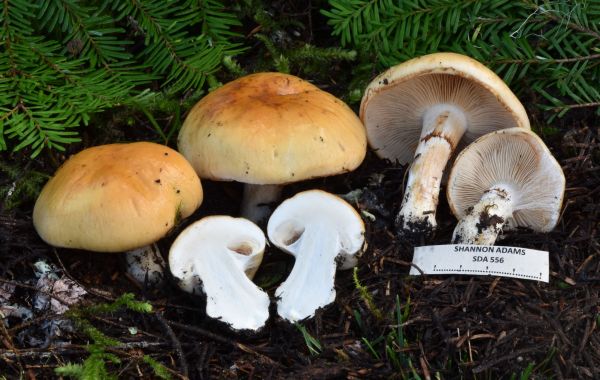
Cortinarius pini

Cortinarius pini Brandrud, Edinburgh Journal of Botany 53: 360 (1996) SDA 621 Cortinarius pini Description:Cap 15-55 mm across, thinly viscid, to dry with adhering debris, yellow-brown with paler margin (cinnamon rufous to cinnamon buff), hygrophanous blotches and streaks towards margin stipe 50-80 mm long, 7-11 mm thick at apex, sub-clavate, with pallid to cinnamon brown... Continue Reading →

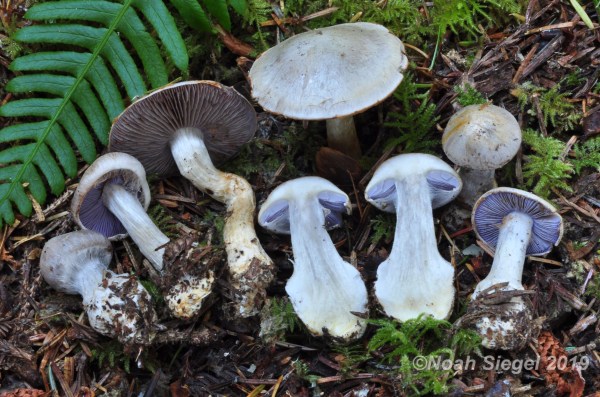
Cortinarius albescens

Cortinarius albescens A.H. Sm., Lloydia 7 (3): 180 (1944) [MB#285690] Description:Cap 25-90 mm across, at first convex with broad umbo, spreading to plane, glutinous, variable in color from violaceous grey, buff, drab, cream to yellow-ochre on disc, cortina white, gills lavender, grayish-lavender, grey to cinnamon-brown, lavender tones may persist, stipe 50 - 120 mm long, 6 - 14 mm wide at... Continue Reading →

Cortinarius turmalis

Cortinarius turmalis Fr., Epicrisis Systematis Mycologici: 257 (1838) [MB#244528]Synonym: Cortinarius corrugis A.H. Sm. (1944) Collection DescriptionsCap 40-135 mm across, hemispherical when young, then convex to plane with slight umbo, undulating in age, surface viscid when wet, rugulose, glabrous, light yellow-ochre at first, becoming darker particularly on disk, cortina abundant, white, gills close to crowded, cream when young, later buff... Continue Reading →

Cortinarius boulderensis

Cortinarius boulderensis (Cortinarius boulderensis A.H. Sm., Lloydia 7 (3): 206 (1944) [MB#285705] Discussion:Cortinarius boulderensis is a small and slender mushroom, notable for its vinaceous brown tones and bright cinnamon-orange annular band. It is in Section Telamonia. Placement in Telamonia sensu strictu by Soop, Dima, Cooper et al. "A Phylogenetic approach to a global supraspecific taxonomy... Continue Reading →

Cortinarius seidliae

Cortinarius seidliae Ammirati, Niskanen & Liimat. (2015)Discussion:Cortinarius seidliae is a relatively common species in the Pacific Northwest. It falls into Section Defibulati, along with Cortinarius vanduzerensis and C. mucifluus. Species in this section are medium to large with glutinous cap and stipe. Microscopy is important; they have large amygdaliform to citriform spores and no clamp... Continue Reading →

Cortinarius camphoratus

Cortinarius camphoratus (Fr.) Fr., Epicrisis Systematis Mycologici: 280 (1838) Discussion:Cortinarius camphoratus is a relatively common species in the Pacific-Northwest, recognized by it's larger size, lilac to almost-white color, non-viscid cuticle and heavy lilac to white veil. The species has a distinctive and unpleasant odor described as rotten potatoes. If you are able to detect it,... Continue Reading →

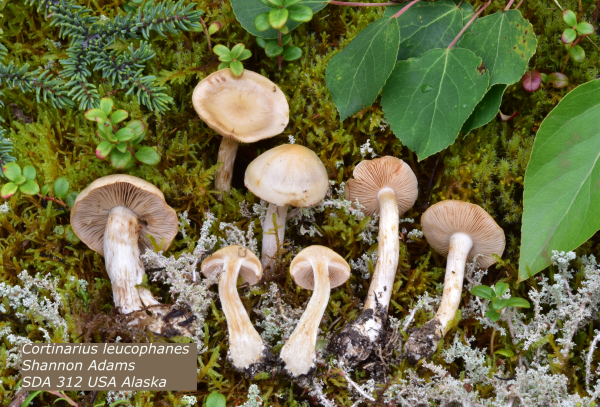
Cortinarius leucophanes

 Cortinarius leucophanes P. Karst., Meddelanden af Societas pro Fauna et Flora Fennica 6: 3 (1881) Description Cap 12-40 mm across, viscid, cream to white with yellow-ocher disc, slight grey to tan concentric pattern, cortina white, gills pallid, stipe: 23-56 mm long, 4-8 mm thick at apex, flesh off-white, becoming orange-brown, odor and taste indistinct, KOH... Continue Reading →

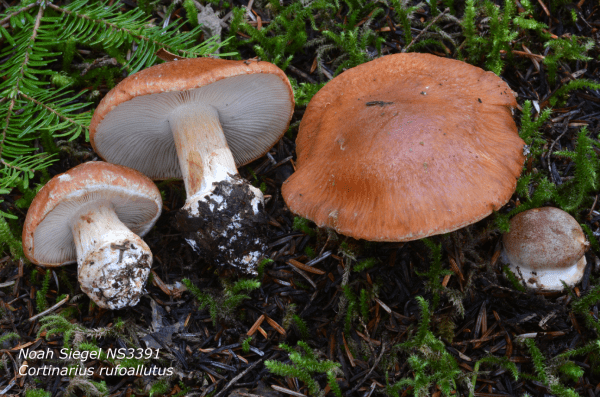
Cortinarius rufoallutus

Cortinarius rufoallutus ((Rob. Henry ex Bidaud & Reumaux), Atlas des Cortinaires 16: 1095 (2006) Collection Description (NS3391) - USA Washington State:Cap 35-89 mm across, with a grayish bloom when young, rugose, more orange and thinly viscid in age, stipe 39-65 mm long, 12-15 mm thick at apex, base slightly bulbous with a short abrupt top,... Continue Reading →

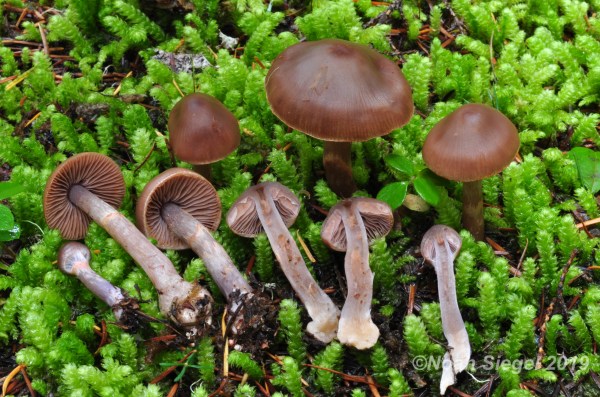
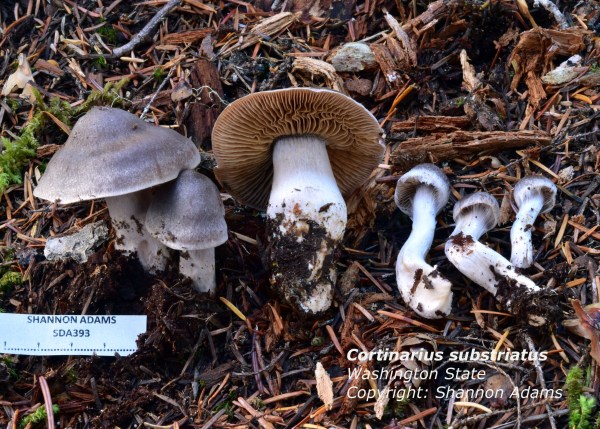
Cortinarius substriatus

Cortinarius substriatus Kauffman, North American Flora 10 (5): 307 (1932) Collection(s) sequenced: SDA 393 – Pierce County, WA. October 2019; SDA 05B Vancouver Island, October 2016. Shannon Adams Description: Pileus: 38-52 mm across, conic, conic-campanulate to convex, viscid to dry, brown to vinaceous grey-brown, when dry - coated with fine whitish innate fibrils, white cap margin. Stipe: 60-86... Continue Reading →

A WordPress.com Website.

Up ↑