There are a number of spring Cortinarius that are similar and are mainly differentiated by subtle fatures in spore size, and extent and color of UV reaction. After recurrent confusion, I put together these notes to help you with ID. This is not a complete note. I will continue to add to it and welcome... Continue Reading →
To support my talks to introduce the new Cortinariaceae to mushroom clubs I created a Mind Map of the new genera proposed by Liimatainen and others in their 2022 paper ((Liimatainen et al. 2022) . I am sharing it here to help you understand the proposed placement of sections and species across genera, and recognize... Continue Reading →
Phlegmacium melleum

Phlegmacium melleum Bojantchev, S.D. Adams & Ammirati Etymology (Latin): melleus meaning honey colored. Description Pileus 40–80 mm diam., hemispherical to convex when young, plano-convex to planoconcave in age margin involute, pinkish buff initially, developing a pink to reddish orange disk, pale yellow at maturity, smooth, glutinous when wet. Lamellae crowded, faintly lilac or beige at... Continue Reading →
Cortinarius aff veneto-occidentalis
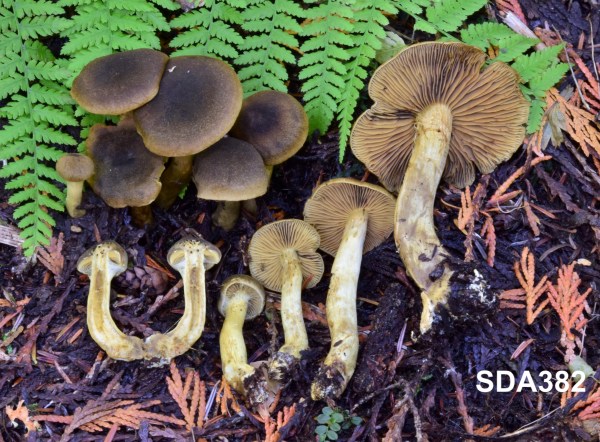
An olivaceous-yellow to brown Leprocybe in section Veneti. It is less common than Cortinarius clandestinus, and occurs exclusively in fall. It has more olive-brown tones than C. veneto-occidentalist sensu strictu, which is known only from boreal forests.
Cortinarius clandestinus

Consider Cortinarius clandestinus when you find a Leprocybe with a black-scaley cap and cream to greenish-yellow tones. It one of few Leprocybe that fruit in Spring, making Spring ID easier. However, C.clandestinus may also fruit in fall so it's not that easy!
Cortinarius olsoniae

Cortinarius olsoniae is in Subgenus Telamonia Section Bicolores. This species was named for Joann Olson, a Cortinarius enthusiast from Humboldt County, California, who first collected this species. It was given the provisional name of Cortinarius 'winter blues' in Mushrooms of the Redwood Coast (2016)
Cortinarius rubiginosus
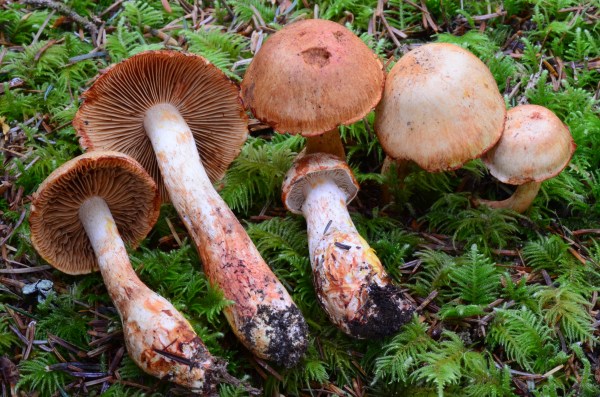
The best features to identify this mushroom are the creamy-beige to yellowish-beige cap that develops ocher-orange colors, the tan to light brown gills that darken to rusty-orange, rusty orange spores and especially the bright yellow-orange staining, which slowly becoming ocher-red to reddish-orange.
Cortinarius armeniacus
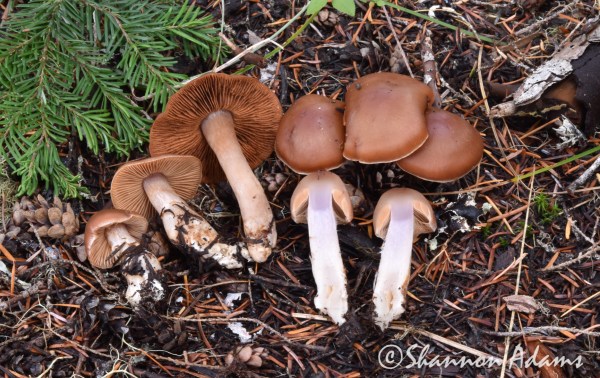
Cortinarius armeniacus is not often collected in our region, but is likely overlooked due to inconspicuous colors and general neglect of Cortinarius species. It can be recognized by the smooth to shiny, hygrophanous yellow to chestnut-brown cap with white margin, firm whitish-drab stipe and convex cap with low umbo
Cortinarius fructuodorus
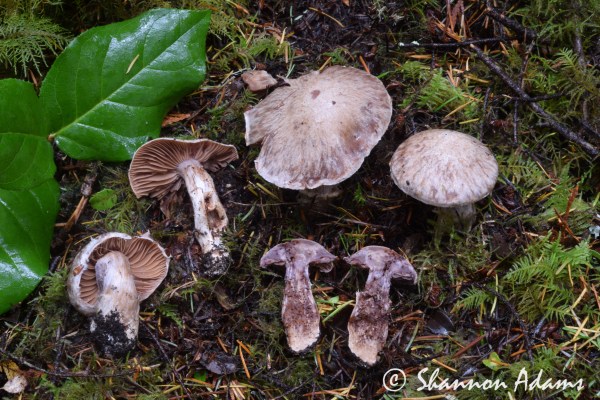
Cortinarius fructuodorus is best recognized by the Cortinarius traganus-like fruity pear odor for which it is named, overall brown (or slightly purple-brown tones) and spores in the range of 8.5-10 x 5.0-6.0 microns. This species is one of several larger pale Telamonia in our region which need further study.
Cortinarius pitkinensis

Cortinarius pitkinensis is a yellow-to-orange gilled Dermocybe known to occur at higher elevation in mossy drainages. It is likely to be misidentified as Cortinarius croceus or Cortinarius cinnamomeus - the most widely known names for yellow and orange-gilled Dermocybe. As it happens, there are many similar species which are challenging to differentiate.
 North American Cortinarius Collections