
Cortinarius aff veneto-occidentalis Niskanen, Liimat. & Ammirati
Common name: “The Western venetus”
Description
Pileus 30-60 mm across, convex to plan, surface dry and tomentose with margin more fibrillose, disc blackish brown, brown to olive brown , marging lighter yellow-ochre to olive yellow. Overall, brownish to red-brown in age while yellow-olive colors are pronounced in younger specimens. Lamellae olivaceus yellow to dull yellow buff, browning in age with some reddish stains. Stipe 38-93 mm long, 5-18 mm wide at apex, clavate, sometimes broadly bulvous, pale olive buff, basal mycellium yellow-buff to olive. Veil yellow, visible on lower half of stipe, sometimes with chevrons and patches. Flesh: Whitish buff to pale yellow.
KOH: dark olivaceus brown on cap to red-brown on stipe surface. UV: Gills and stipe yellow, stipe veil and pileus no reaction.
Spores: “7– 8.1(– 8.5 – 9.6) × 5.6 – 6.7(–7–7.8) μm, L × Wm 7.5 × 6.1 μm, Q (1.1–)1.2 –1.3(–1.4), Qm 1.26” (Ammirati, J., K.Liimatainen et al, 2021)
Habitat and Ecology
Cortinarius aff veneto-occidentalis is known from the Washington Cascades
Photographs

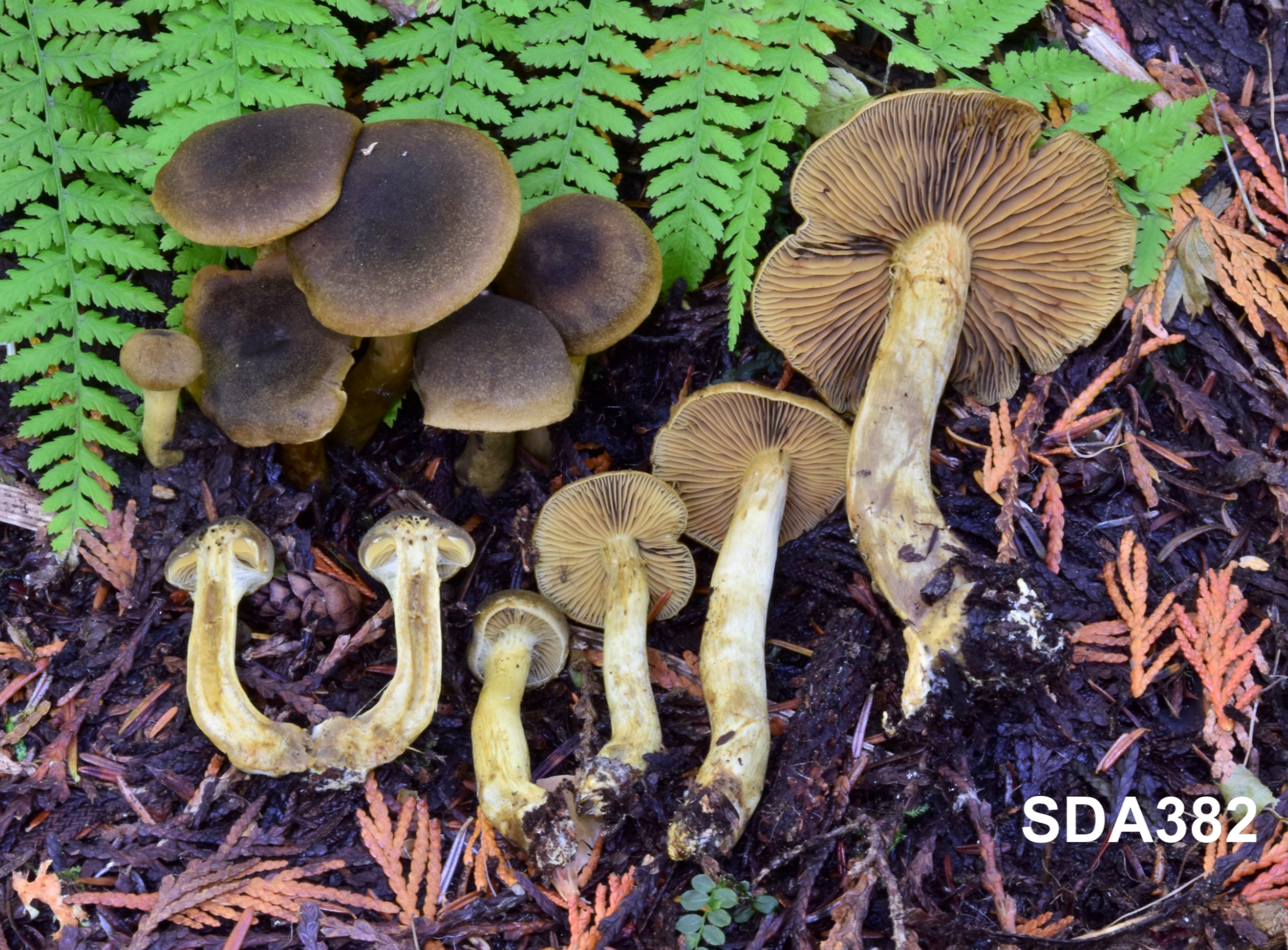
Discussion
Before writing much more I am going to say that I find Leprocybe difficult. It is easy to figure out that something is a Leprocybe, and zap it with UV and feel a surge of conviction, but you may lose your bravado when you try and figure out which one. Ah, then the going gets a little tough. Cortinarius veneto-occidentalis is another of the puzzles. All of my collections (including one discussed in the paper) turn out (again) to be an aff. C.veneto-occidentalis which is given a detailed treatment because it doesn’t look like those in sensu strictu.
Ammirati, J. K. Liimatainen et al, (2021) differentiated this variety from the type of Cortinarius veneto-occidentalis because of it’s distinctly darker olivaceous cap surface. While C.veneto-occidentalis sensu strictu is known from boreal forests in Alaska and Alberta, the olivaceus form is known from WA, OR, CA, CO and WY. The fact that C.veneto-occidentalis can also have olivaceous forms, as well as C.clandestinus means that identification may take detailed analysis.
Based on my collecting in WA and OR, this species is less common than C.clandestinus or C.atrosquamosus in the Cascade habitat.
Phylogenetics
C. veneto-occidentalis is in section Veneti within Subg. Leprocybe. Per Ammirati, Liiimatainen et al (2021) this section is characterized by:
“Basidiomata rather small- to medium-sized. Pileus generally olive yellow to yellowish brown or olive brown, but also dark olive brown to blackish brown, innately fibrillose, tomentose or with ± small, fibrillose scales, ± hygrophanous. Stipe cylindrical to somewhat clavate. Veil olive yellow to greenish yellow. Basidiospores relatively small, L × Wm 7.2 × 5.8 μm.“
In terms of ITS, C.aff veneto-occidentalis is placed between C. veneto-occidentalis sensu-strictu and C. fuscoflavidus. Are they on a continuum in the process of speciation? Please collect more and help us figure this stuff out.
References
Ammirati J, Liimatainen K, Bojantchev D, et al. 2021. Cortinarius subgenus Leprocybe, unexpected diversity and significant differences in species compositions between western and eastern North America. Persoonia 46: 216 – 239. https://doi.org/10.3767/persoonia.2021.46.08. Effectively published online: 27 May 2021
 North American Cortinarius Collections
Leave a comment